
Running a Sex Offender Check in Wabash County
The primary public channel is the Illinois State Police Sex Offender Registry. It can be filtered to Wabash County or narrowed by a person's name, date of birth, city, ZIP code, status, homelessness indicator, or offender type. ISP says the database is updated daily, but also cautions that information may have been supplied by a registrant and may be inaccurate. Treat a match as a starting point and confirm it with the registering agency displayed on the profile.
Local public access is also available through the relevant police department or sheriff under Illinois community-notification law. A person living in a municipality ordinarily registers with municipal police; a person outside a municipality with a police chief registers with the sheriff. Requests may be made in person, in writing, or by phone, subject to statutory limits and actual copying costs. For a useful search, begin with a full name and one additional identifier, then use geography to distinguish similar names.
Entering the ISP Registry Through Its Disclaimer
The ISP portal does not open directly onto a result list. Its disclaimer explains that the registry is not a complete criminal history, cannot predict future behavior, and may contain inaccurate information. The visitor must choose Agree before reaching the search interface. Choosing Do Not Agree ends that route. Reading this notice matters because it frames both the limits of the data and the obligation to use it lawfully.
The official ISP disclaimer page shows the controlled entry point used before a search.
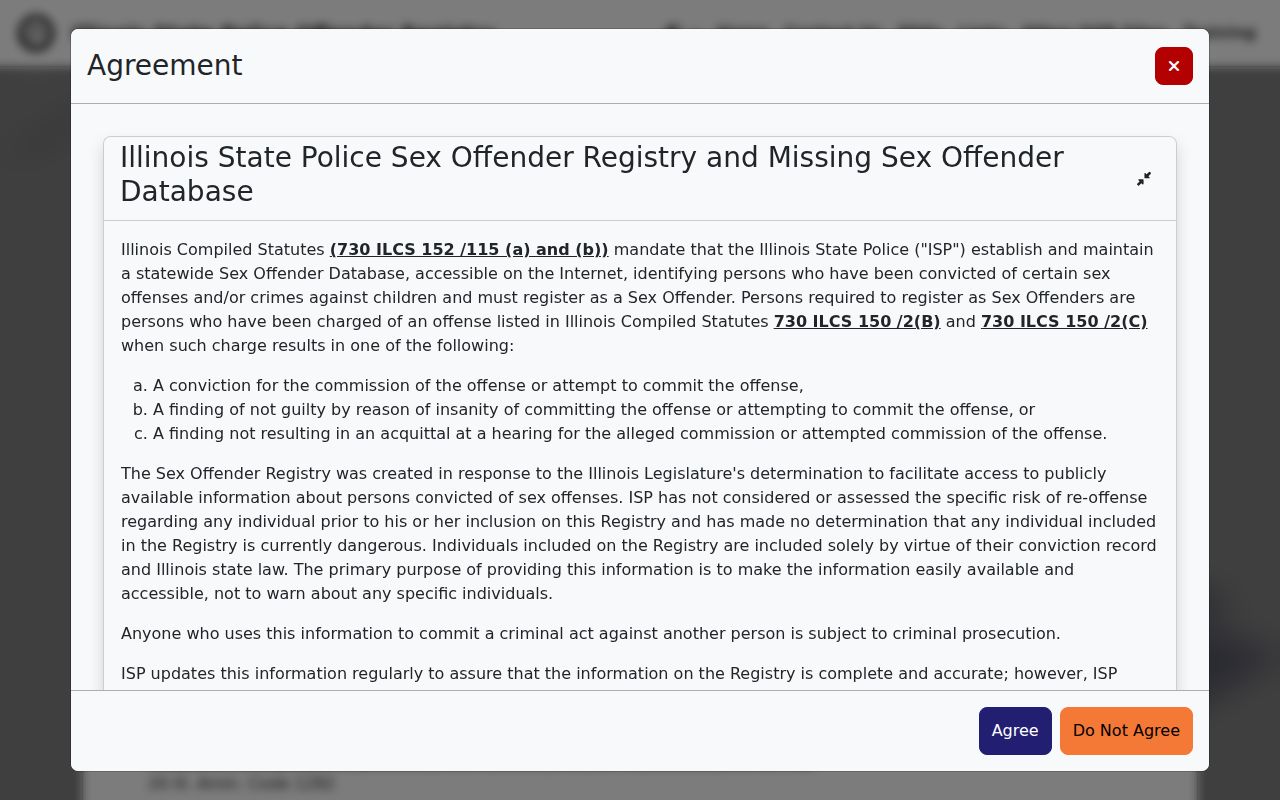
That gate is a reminder to verify a listing rather than treating the first screen as a final finding.
Searching the Illinois State Police Sex Offender Registry
Illinois State Police operates the statewide search. Wabash County is one option in the county dropdown, alongside categories for incarcerated and out-of-state records. All listed fields are optional, so a broad county search can be refined after reviewing the result set. Name searches work best when spelling and aliases are considered, while city and ZIP searches help focus on a particular area.
- Open the ISP disclaimer, read the conditions, and select Agree to enter the registry.
- Enter a name or date of birth, or choose Wabash County and add city, ZIP, status, homeless, or offender-type filters.
- Compare the result list by photo, age, aliases, and location rather than relying on a name alone.
- Open the profile, note its registering agency and status indicators, and contact that agency to verify information that affects a safety decision.
| Field Label | Type | Required | Notes |
|---|---|---|---|
| First and Last Name | Text | No | Use either or both; review possible aliases on profiles. |
| Date of Birth | Date/text | No | Useful for separating people with similar names. |
| City and ZIP Code | Text | No | Narrows results to a community or postal area. |
| County | Select | No | Select Wabash; the menu also includes incarcerated and out-of-state categories. |
| Status, Homeless, Offender Type | Select/checkbox | No | Additional filters for the statewide dataset. |
| Map Your Neighborhood | Address/map point | No | Maps registered offenders within five miles under 730 ILCS 152/115. |
Map Your Neighborhood Within Five Miles
ISP's Map Your Neighborhood feature accepts an address or map point and displays registered offenders within a five-mile area. This is useful for geographic awareness when a name is not known. A mapped marker still requires the same careful profile review and agency confirmation as a name result. The map is a registry view, not a statement that every offense occurred near the displayed address.
The official Illinois registry search demonstrates the available search route after the disclaimer is accepted.
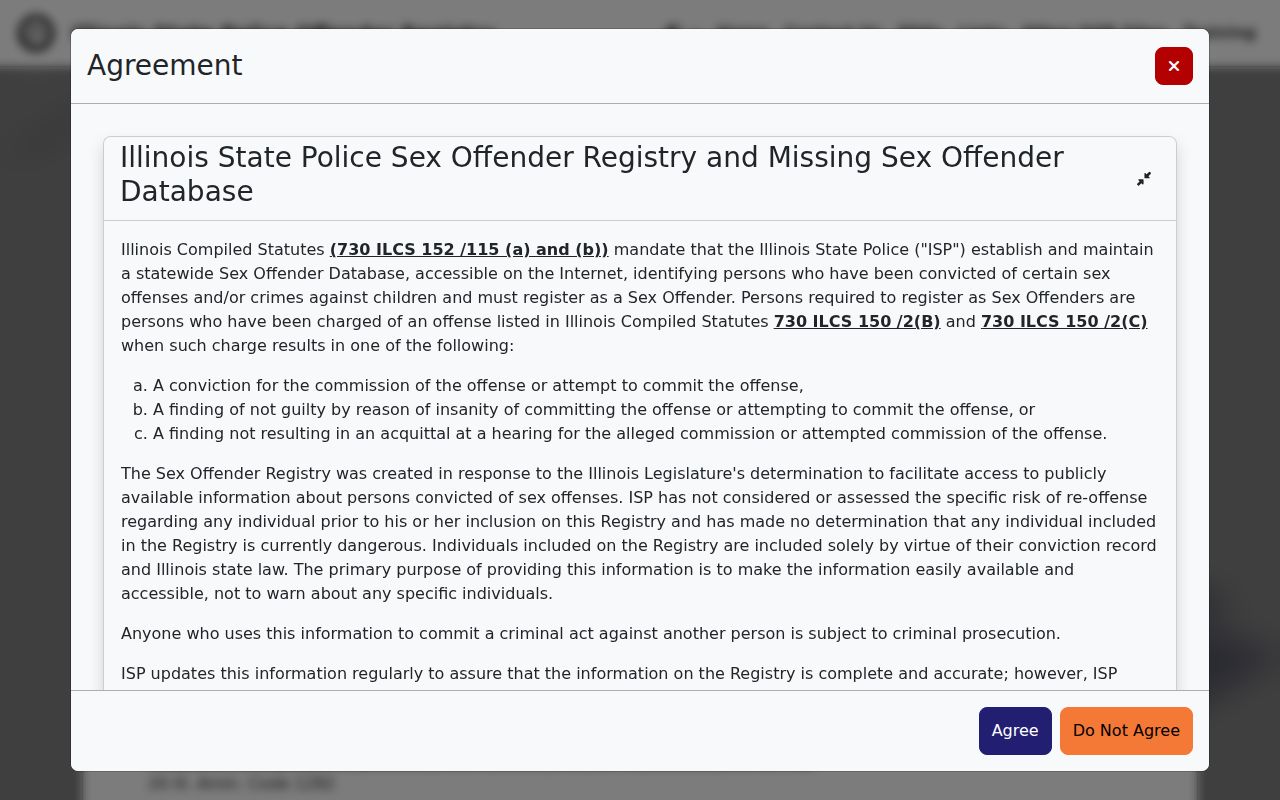
Location filters make a county search manageable, but the current registering agency remains the verification point.
What a Registry Profile Shows
A public profile can combine identity, location, offense, and registration information. It may show name and aliases, age or date of birth, photo and physical descriptors, an address or other location display, conviction county, offense statute and dates, offender classification, compliance indicators, and the registering agency. Authorized public-safety disclosures may also include work or school information, vehicles, plates, or distinguishing marks. Availability varies by profile.
| Name & Aliases | Reported identity names, aliases, age, or date of birth used to distinguish a person. |
|---|---|
| Photo & Physical Description | Photograph, physical characteristics, and possibly distinguishing marks or tattoos. |
| Registered Address | Public location detail permitted by law; confirm currency with the registering agency. |
| Offense & Statute | Registry-qualifying offense, statutory reference, relevant dates, and conviction county. |
| Classification | Category such as sexual predator or another registrable offender, not a complete risk prediction. |
| Registration Status | Compliance or status indicators and the agency responsible for registration. |
A Registry Profile Is Not a Full Criminal History
A registry profile answers a narrower question than an ISP criminal-history transcript or a Wabash Circuit Court file. It focuses on information Illinois law makes public for registration and notification. It does not necessarily include every arrest, every non-registerable conviction, the complete docket, all evidence, or the final wording of every court order. For the underlying prosecution, use the Wabash County criminal court case route and request the judgment or certified record from the Circuit Clerk when necessary.
The ISP operational FAQ explains registry categories and public access.
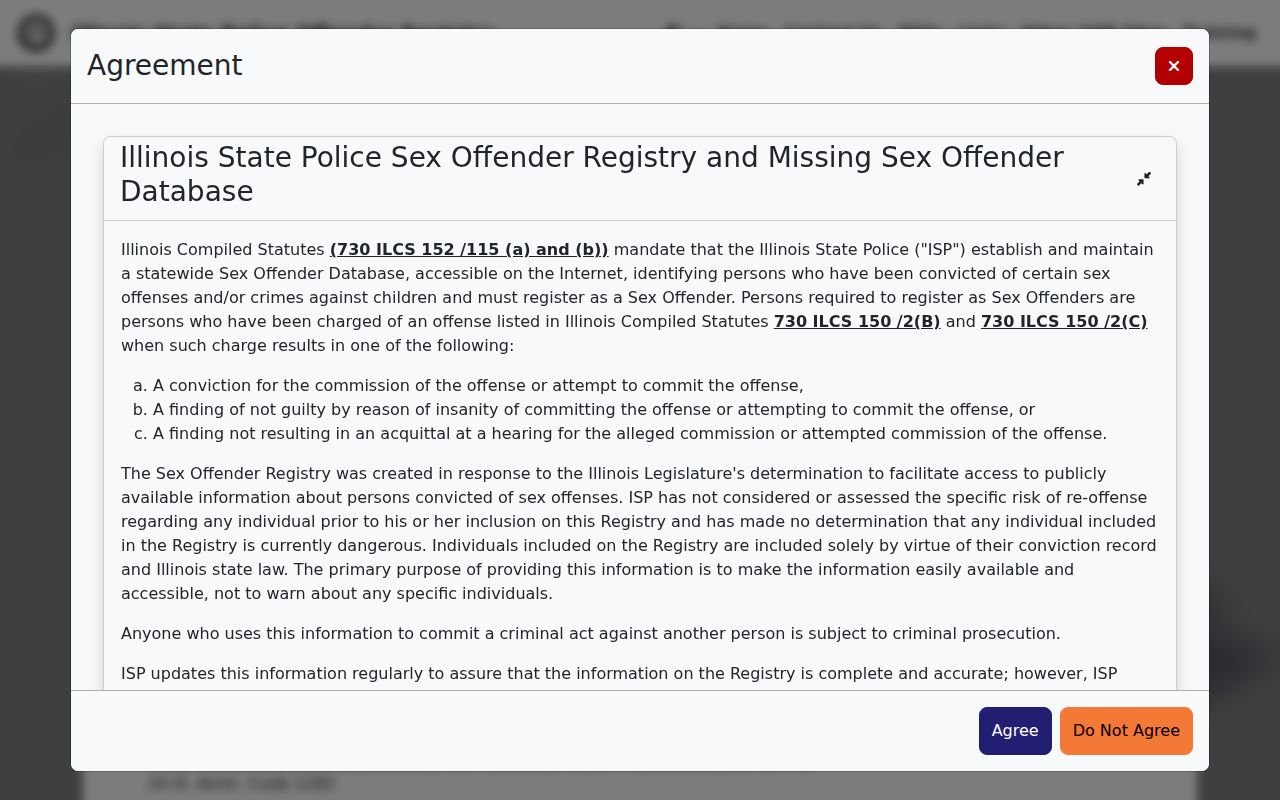
Reading the registry and court record together prevents a public profile from being mistaken for a complete case history.
Registration Requirements and Levels in Illinois
Illinois uses statutory categories and duties rather than a simple public three-tier chart. Duration and verification frequency depend on the classification and applicable law. Deadlines for registering or reporting changes can be as short as three days. The table summarizes the categories documented by ISP and the governing statutes, but the registering agency should confirm the schedule for a specific person.
| Level / Tier | Duration | Verification Frequency |
|---|---|---|
| Other registrable sex offender | Generally 10 years after the applicable conviction or release point | Generally annual |
| Sexual predator | Natural life | Annual under the ISP FAQ |
| Sexually dangerous or sexually violent person | Natural life | Every 90 days |
| Specified post-July 1, 2005 SOR violation | Applicable statutory duration | Every 90 days |
| Registering first-degree murderer | Natural life | Annual |
Mount Carmel Police or Wabash Sheriff
Registration responsibility turns on residence and local police structure. A registrant living in Mount Carmel ordinarily reports to the Mount Carmel Police Department. Someone residing outside a municipality that has a police chief ordinarily reports to the Wabash County Sheriff's Office. The profile's agency field should resolve uncertainty. Local public-access requests under 730 ILCS 152/120 may be directed to the municipal police department or sheriff in person, by writing, or by phone.
Published fee sources do not reconcile cleanly. The ISP FAQ identifies a $100 initial and annual statutory amount, while Wabash County Ordinance No. 30 publishes a $30 sex-offender registration fee. The scope may differ, so do not add the figures together or quote a payable total without calling the registering agency. The Wabash Sheriff's Office and jail are at 110 East Fourth Street, Mount Carmel, and the main office number is 618-262-4186.
The Illinois registration-duties statute provides the governing framework.
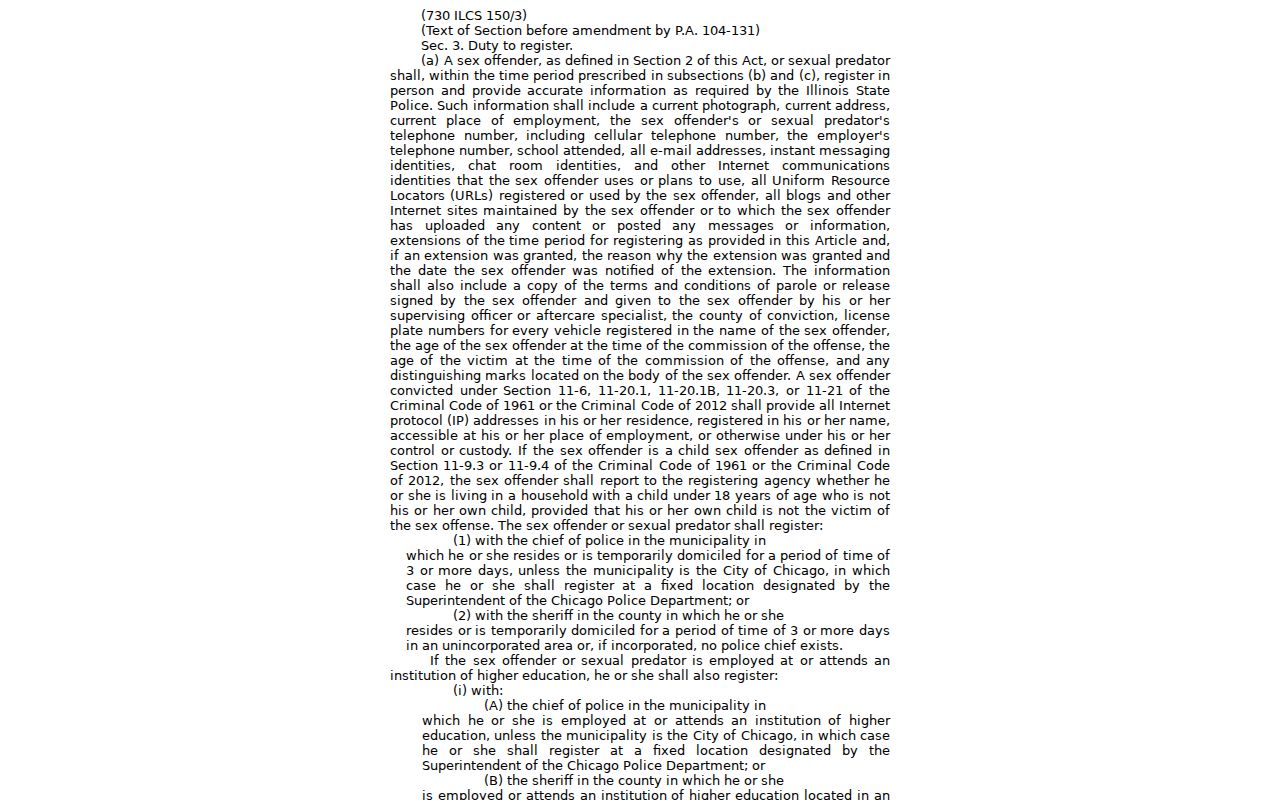
The statute and profile agency field should guide where a Wabash County resident confirms a duty or update.
Ten Years, Life, Annual or 90 Days
Duration and verification are separate concepts. A ten-year registration period does not mean a ten-year gap between check-ins, and lifetime registration does not by itself identify whether verification is annual or every 90 days. Classification, offense date, statutory changes, release dates, and later violations can all matter. The safe approach is to read the profile category, consult the applicable statute, and confirm the precise obligation with the registering agency.
The Illinois registration-duration statute sets out key time rules.
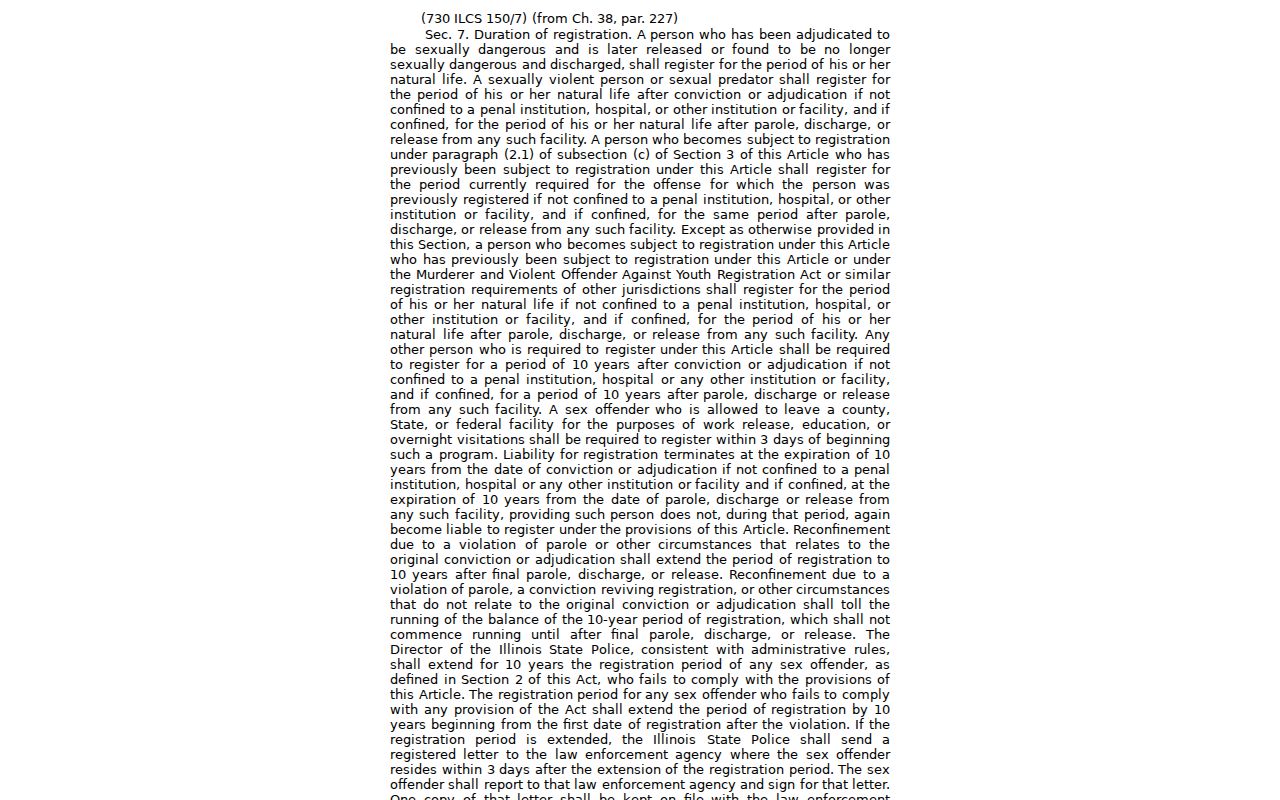
This distinction explains why two profiles can have different reporting schedules even when both remain publicly visible.
Using NSOPW Across the State Line
Wabash County sits on the Illinois border, so an Illinois-only result may not answer a cross-state location question. The U.S. Department of Justice's National Sex Offender Public Website, or NSOPW, searches participating jurisdiction registries through one national interface. Use it as a supplement when an address, workplace, school, or recent move may cross state lines. If the ISP portal is unavailable, NSOPW is also a practical fallback, followed by confirmation with the registering agency.
The official NSOPW search provides the national layer.
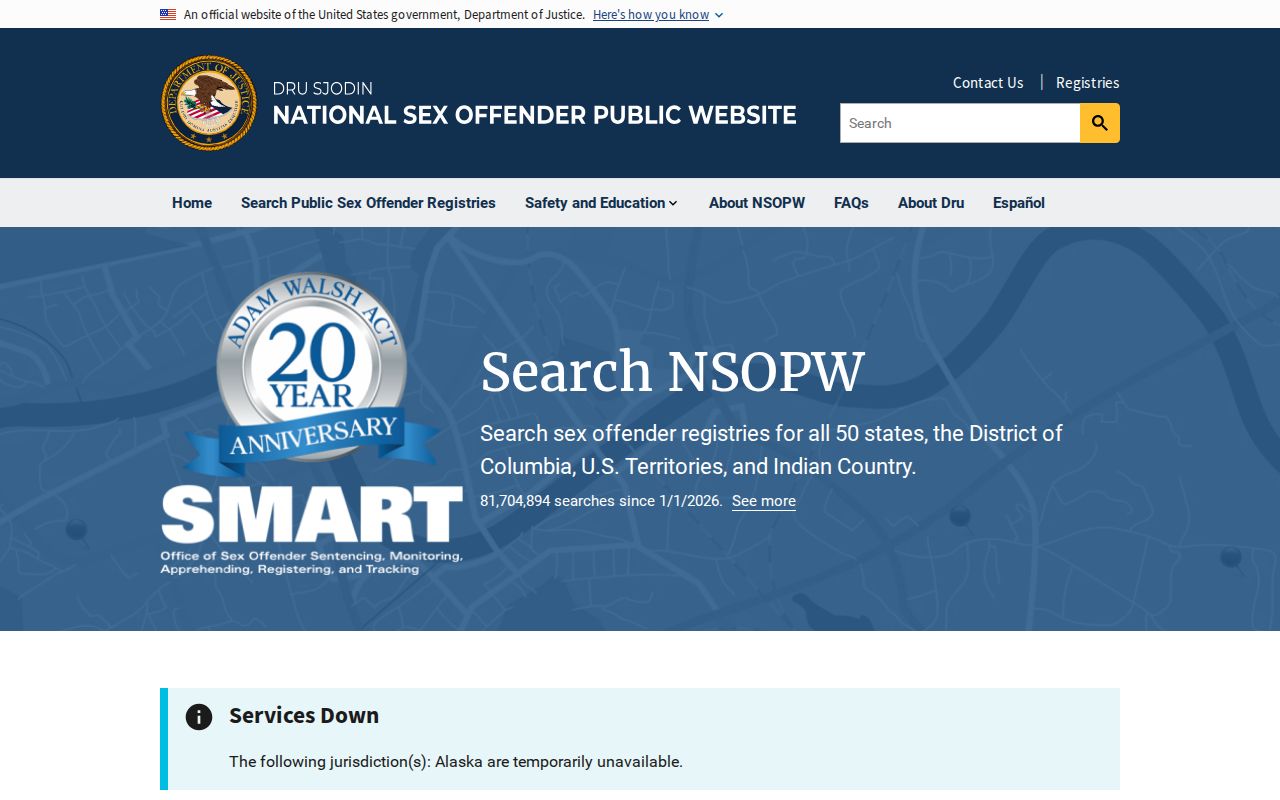
A national match should still be opened at its source jurisdiction and verified locally before reliance.
Lawful Use and Community Notification
Registry information supports personal, family, neighborhood, and community safety awareness. It may help a resident understand a nearby listing, review a map area, or identify which law-enforcement agency to contact about suspected noncompliance. It is not permission for confrontation, surveillance, threats, or independent enforcement. Report a suspected violation to the registering agency or other law enforcement and let that agency investigate.
Residency restrictions are also category-specific and include statutory definitions and exceptions. Do not assume every registrant is governed by the same 500-foot rule. Consult the applicable Illinois statute and the registering agency rather than applying a distance rule from one profile to everyone.
Misuse is prohibited: Illinois law, including 730 ILCS 152/120, does not authorize harassment or criminal misuse of registry information. Never threaten, stalk, intimidate, or harass a registrant or family member. Send suspected noncompliance to law enforcement.